
 English
 German
 Dutch
Dutch
 Other
Other









Feza Gürsey: De Turkse natuurkundige die de moderne theoretische wetenschap vormgaf
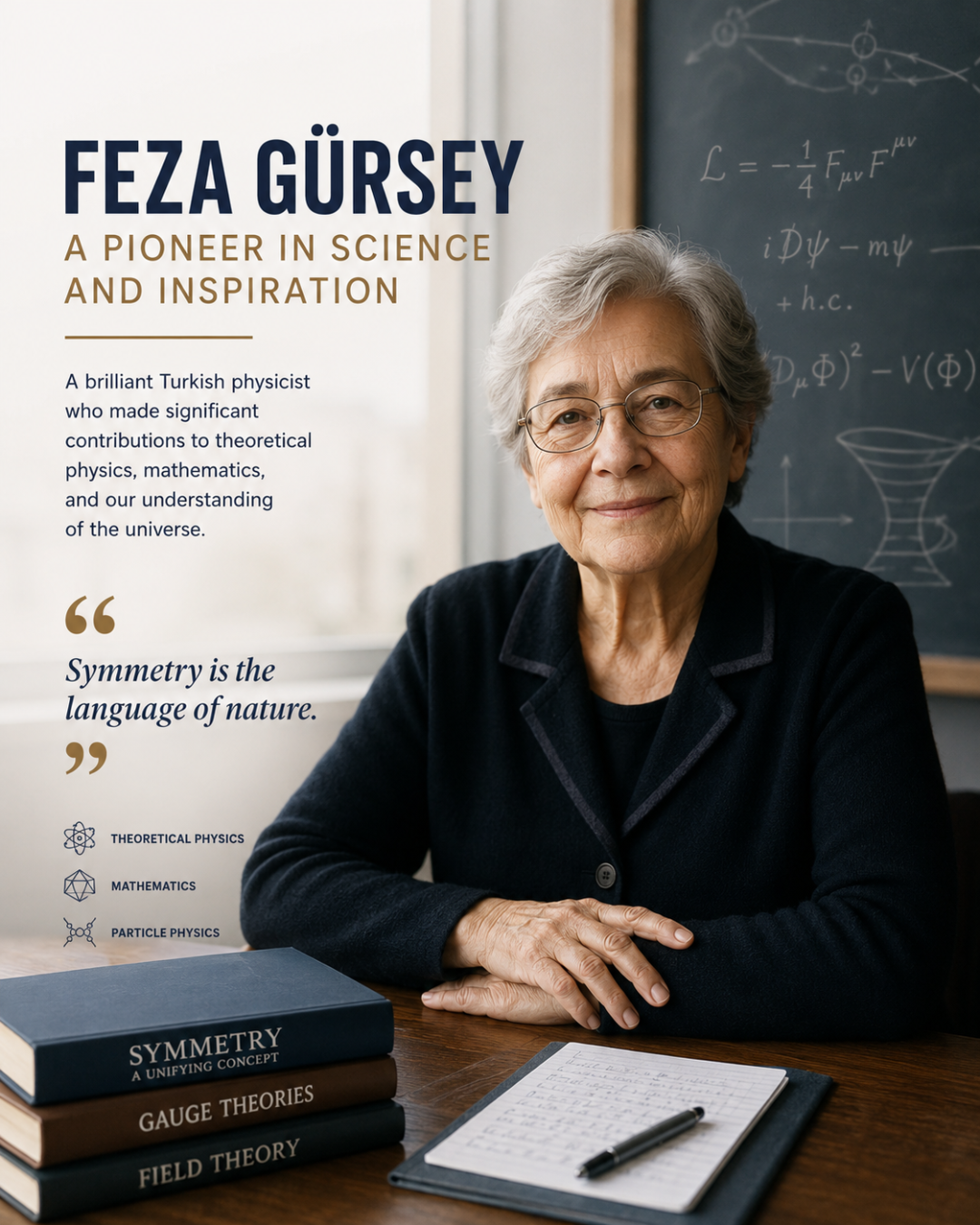
Feza Gürsey was a Turkish physicist and mathematician whose work in theoretical physics has had a profound impact on modern science. Born in Istanbul in 1921, Gürsey showed an early aptitude for mathematics and physics, which led him to pursue advanced studies in the field. His academic journey took him from Istanbul University to the University of Cambridge and later to Princeton, where he collaborated with some of the brightest minds in physics.
Gürsey is best known for his contributions to the study of symmetry in particle physics. His work on chiral symmetry and nonlinear sigma models provided key insights into the fundamental forces of nature. These theories have since become foundational in understanding the behavior of subatomic particles, influencing research in quantum field theory and beyond. In 1964, he introduced the Gürsey model, a mathematical framework that helped explain the interactions between particles in a way that was both elegant and groundbreaking.
Beyond his research, Gürsey was a dedicated educator. He taught at Istanbul University and later at Yale University, where he inspired generations of students. His ability to simplify complex concepts made him a beloved figure in the academic community. Gürsey’s work earned him international recognition, including the prestigious Wigner Medal in 1986, awarded for his outstanding contributions to the understanding of symmetry in physics.
Gürsey’s legacy extends beyond his scientific achievements. He was a bridge between Eastern and Western scientific communities, fostering collaboration and exchange of ideas. His life and work continue to inspire physicists and mathematicians around the world, reminding us of the power of curiosity and intellectual rigor.
Tijdlijn van belangrijke prestaties:
- 1921: Geboren in Istanbul, Türkiye.
- Jaren 1940: Studied at Istanbul University and later at the University of Cambridge.
- Jaren 1950: Begon onderzoek naar symmetrie in de deeltjesfysica, waardoor de basis werd gelegd voor toekomstige ontdekkingen.
- 1964: Introduceerde het Gürsey-model, een belangrijke bijdrage aan de theoretische natuurkunde.
- 1974: Trad toe tot Yale University als professor, waar hij zijn onderzoek en onderwijs voortzette.
- 1986: Ontving de Wigner-medaille voor zijn bijdragen aan symmetrie in de natuurkunde.
- 1992: Overleden, achterlatend een erfenis van wetenschappelijke innovatie en onderwijs.