
 English
 Turkish
 Hindu
Hindu
 Other
Other









Ali Kuşçu: The Ottoman Astronomer Who Bridged East and West
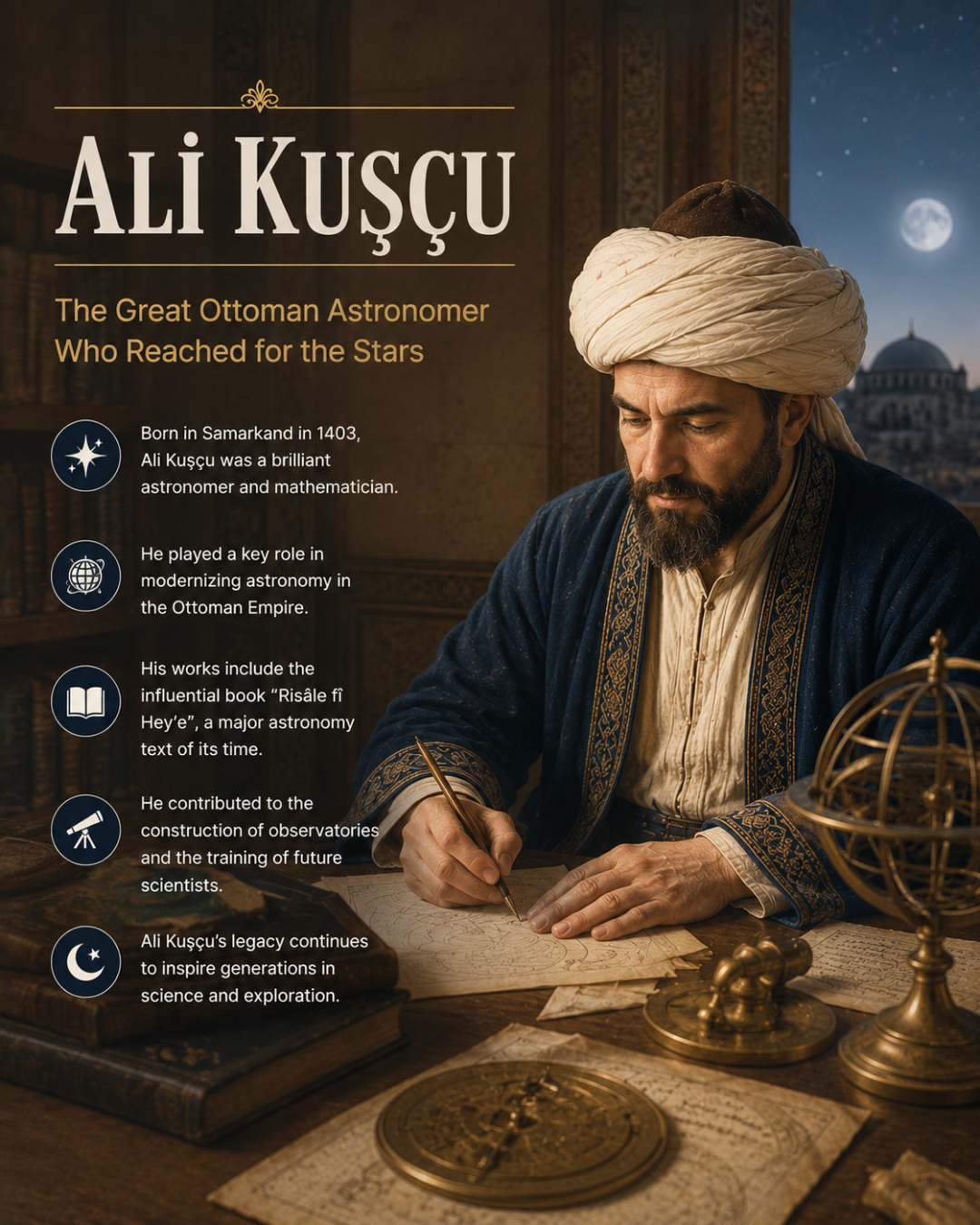
Ali Kuşçu, born in the early 15th century in Samarkand (present-day Uzbekistan), was a scholar whose work in astronomy, mathematics, and theology influenced the Islamic world and beyond. His name, meaning "bird-like" in Turkish, reflects the freedom of thought he embodied as a scientist and educator.
Kuşçu began his studies under the renowned astronomer Ulugh Beg, who ruled Samarkand and established an observatory that became a center of scientific learning. There, Kuşçu contributed to the Zij-i Sultani, a groundbreaking astronomical table that improved calculations of celestial movements. His expertise earned him a place among the leading scientists of his time.
In 1472, Kuşçu traveled to Istanbul at the invitation of Sultan Mehmed II, who sought to strengthen scientific and cultural institutions in the Ottoman Empire. He played a key role in reforming the Sahn-ı Seman madrasas, where he introduced advanced curricula in mathematics and astronomy. His works, such as Risale fi’l-Hey’e (Treatise on Astronomy), became foundational texts in Ottoman education.
Beyond astronomy, Kuşçu wrote on theology, philosophy, and linguistics, demonstrating the interconnectedness of knowledge in the Islamic tradition. His legacy endures in modern Türkiye, where institutions and even a lunar crater bear his name, honoring his contributions to science.
Today, Ali Kuşçu is remembered as a bridge between the scientific traditions of Central Asia and the Ottoman Empire, leaving a legacy that continues to inspire.