
 English
 Turkish
 Other
Other










Kimlik (identity card) in Turkey – what foreigners need to know

Kimlik (pronounced keem-leek) is the Turkish word for identity card, the official government-issued photo ID for Turkish citizens and residents. In Turkey, the Kimlik serves as the primary proof of identity for legal, administrative, and financial transactions, including property purchases, banking, and utility registrations.
For Turkish citizens, the Kimlik is a mandatory, chip-enabled smart card containing personal details such as full name, TC Kimlik No (Turkish ID number), date of birth, and address. Foreign residents with a valid residence permit (ikamet) do not receive a Kimlik but instead use their passport alongside their permit for identification.
The Kimlik is distinct from a passport or driver’s license and is issued exclusively by the Turkish Directorate General of Population and Citizenship Affairs (Nüfus ve Vatandaşlık İşleri Genel Müdürlüğü). It is often required when signing contracts, opening bank accounts, or completing real estate transactions in Turkey.
Foreign property buyers should note that while they cannot obtain a Kimlik, their passport and tax number (vergi numarası) serve as equivalent identification for most legal processes. Turkish citizens must present their Kimlik in such cases.
| Turkish Term | English Equivalent | Notes |
|---|---|---|
| Kimlik | Identity card (ID card) | Official Turkish ID for citizens. |
| TC Kimlik No | Turkish ID number | 11-digit unique identifier for citizens. |
| Nüfus cüzdanı | Population register card (older term) | Pre-2016 term; replaced by chip-based Kimlik. |
| Yabancı kimlik numarası | Foreigner identity number | Assigned to residents with a valid ikamet (residence permit). |
| Vergi numarası | Tax number | Required for foreigners in property transactions. |
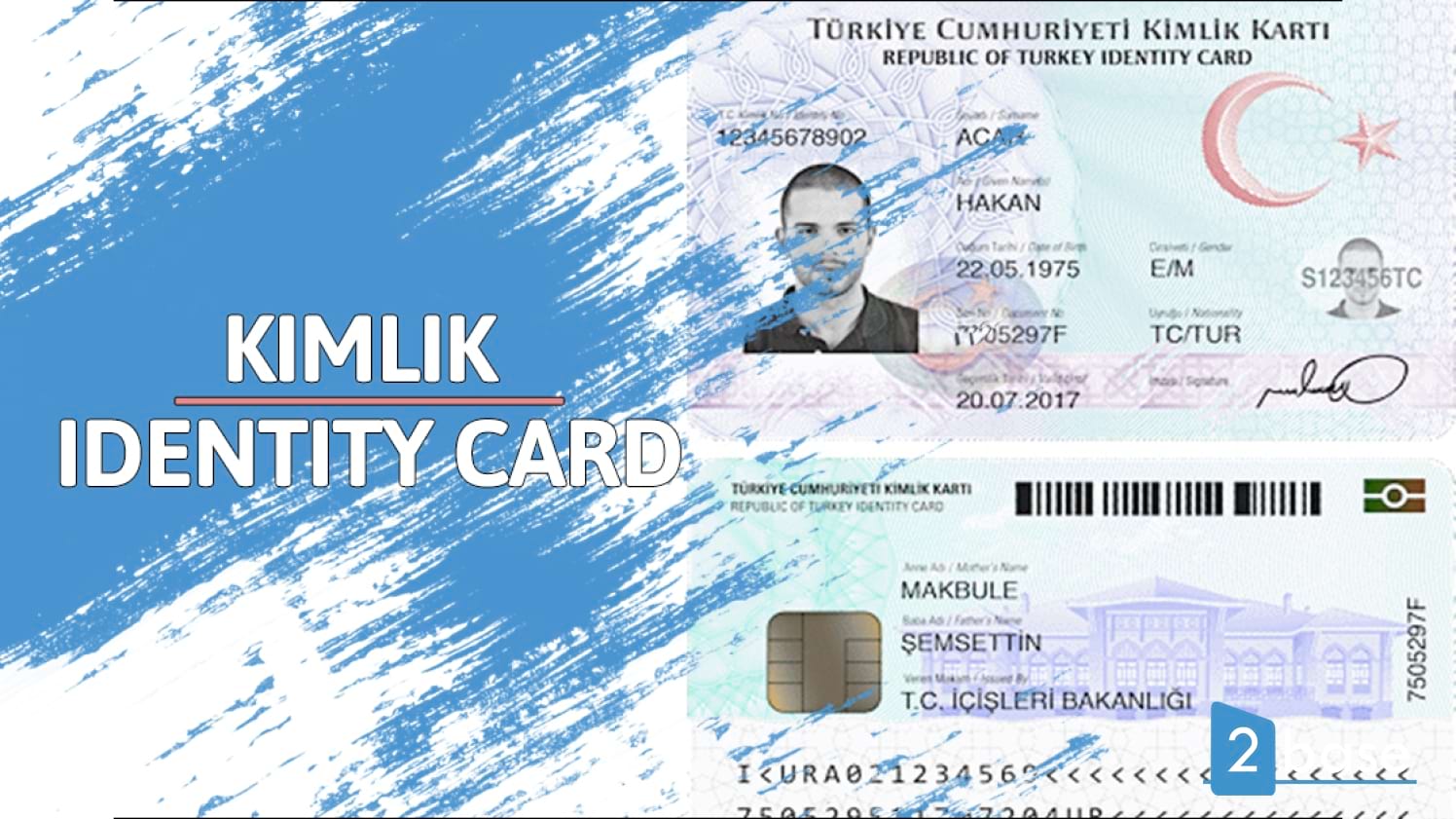
Official Turkish ID card for residents and citizens.
A Kimlik is the national identity card issued to Turkish citizens and legal residents. It contains a unique 11-digit number (TC Kimlik No) and personal details like name, birthdate, and photo.
For foreigners buying property, a Kimlik is often required for legal transactions, utility registrations, and banking. Non-citizens may use a Yabancı Kimlik Numarası (Foreigner ID Number) instead.
Without it, some administrative steps (e.g., title deed transfers) may face delays or require alternative documentation.
Foreigners receive a Yabancı Kimlik Numarası, not a Kimlik.
Foreigners cannot obtain a standard Kimlik, which is reserved for Turkish citizens. Instead, they receive a Yabancı Kimlik Numarası (YKN)—a unique 99-digit ID for legal residents.
The YKN is assigned upon getting a residence permit. It functions like a Kimlik for administrative tasks (e.g., opening bank accounts, signing contracts).
Short-term visitors (e.g., tourists) typically use passport numbers for transactions.
Automatically assigned with a residence permit.
A Yabancı Kimlik Numarası (YKN) is assigned by:
Residence permit application: Göç İdaresi (Migration Office) issues a YKN when approving short/long-term permits. The number appears on the permit document.
Banks accept passports, but a YKN eases the process.
Turkish banks do not strictly require a Kimlik or YKN to open an account—most accept a passport for foreigners. However, providing a YKN can:
- Speed up identity verification.
- Enable online banking access (some banks restrict this without a YKN).
- Simplify future transactions (e.g., mortgage applications, utility payments).
For non-residents, a passport + tax number (vergi numarası) is often sufficient. Residents with a YKN face fewer documentation requests.
Report loss and request a replacement or new YKN.
Foreigners cannot lose a YKN itself (it’s a digital number), but they may misplace documents containing it (e.g., residence permit, tax card). Steps to take:
1. Residence permit loss: Report to Göç İdaresi and apply for a replacement. The YKN remains the same.
2. Tax card loss: Visit the Vergi Dairesi for a reprint. No new YKN is issued.
3. Passport loss: Replace via your embassy. Banks/authorities can re-link your YKN to the new passport.
Turkish citizens must report a lost Kimlik to Nüfus Müdürlüğü for a replacement.
Kimliks don’t expire; YKN validity ties to residency status.
A Turkish Kimlik has no expiration date—it remains valid unless the card is damaged or personal details change (e.g., marriage).
A Yabancı Kimlik Numarası (YKN) itself never expires, but its usability depends on your legal status:
- If your residence permit expires, the YKN stays active but may not suffice for new transactions (e.g., buying another property) until renewed.
- Property ownership isn’t affected by YKN/residency status—once registered under your name (via Tapu), it remains yours regardless of ID validity.
Also read

Asansör (Elevator) – What It Means in Turkish Real Estate

Bina (Building) – Understanding Turkish Real Estate Terms

Damga vergisi (stamp duty) in Turkey – explained for buyers

Emlak (Real Estate) in Turkey – A Simple Explanation for Foreign Buyers

Emlakçı (Real Estate Agent) – Turkey Property Guide

Hisseli tapu (shared title deed in Turkey)

Müteahhit (contractor) – key role in Turkish real estate

Göç İdaresi (Migration Office) in Turkey – Key Facts for Foreigners